Vehicle Model Profile: Benze EQE

Conclusion
-
Exceptional performance and robust range: The dual-motor all-wheel-drive system delivers a maximum power output of 300 kilowatts, accelerating from 0 to 100 km/h in just 4.9 seconds with swift and seamless power delivery. Equipped with a 96.1 kWh battery, it achieves a CLTC range of 681 kilometres, offering a solid displayed range that effectively alleviates range anxiety.
-
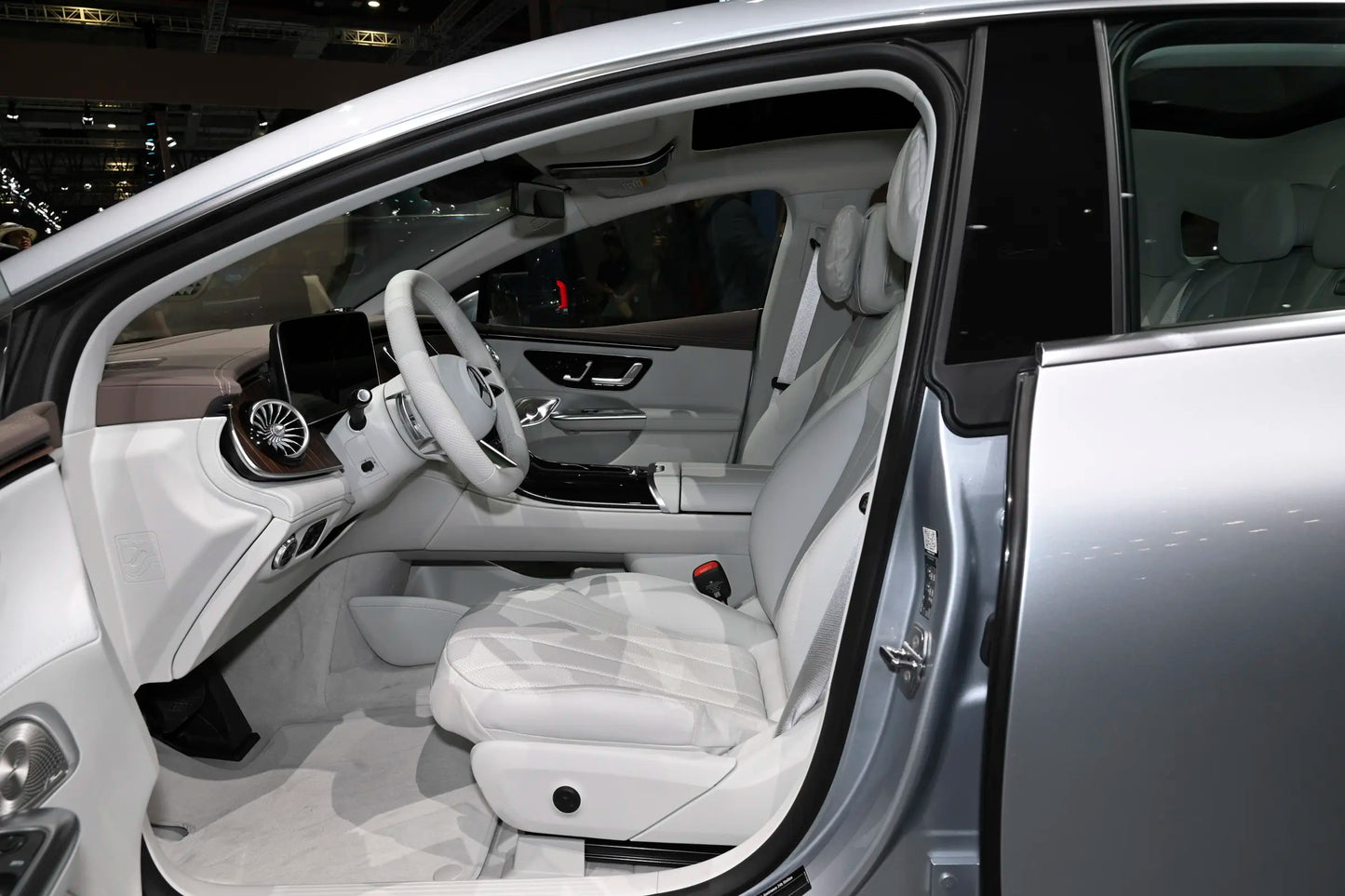
Luxurious Craftsmanship and Intelligent Cabin: The interior upholds Mercedes-Benz's classic opulent style with meticulously selected materials, while ambient lighting cultivates an unmistakable sense of Mercedes-Benz prestige. Featuring a 12.3-inch + 12.8-inch dual-screen display, the MBUX intelligent interaction system and 5G connectivity, it harmoniously blends technological sophistication with luxurious refinement.
-
Comprehensive Driving Assistance and Technology: Supports Level 2 driver assistance, with optional rear-wheel steering and Intelligent Pilot Assist Max enhancing manoeuvrability and long-distance comfort. Standard Burmester® sound system complements extensive comfort features.
Please Note
-
Rear comfort and space design present shortcomings: the rear seat backrest angle is rather upright, and the floor platform is slightly elevated, compromising comfort for the middle passenger; interior storage space is limited, and legroom may feel somewhat cramped for taller occupants.
-
Driver assistance features require optional extras, limiting convenience: The Pioneer Edition's Intelligent Pilot Assist Max function is a paid add-on, and the range of basic driver assistance features could be enhanced compared to competitors. The vehicle's considerable width demands extra caution when navigating narrow urban streets and parking.
-
Charging efficiency and ground clearance: Slow charging takes up to 13 hours, offering merely adequate energy replenishment. The vehicle's low ground clearance necessitates caution when traversing uneven surfaces or navigating underground car parks.
Overview
The 2026 Mercedes-Benz EQE 500 4MATIC Pioneer Edition is positioned as a mid-to-large-sized luxury electric saloon, blending the brand's heritage of luxury with pure-electric drive technology. It prioritises opulent features, formidable performance and intelligent experiences.
The vehicle employs a dual-motor all-wheel-drive system delivering a combined output of 300 kilowatts and peak torque of 858 Newton metres. It accelerates from 0 to 100 kilometres per hour in just 4.9 seconds, with a top speed of 200 kilometres per hour. Equipped with a 96.1 kilowatt-hour ternary lithium battery, it achieves a CLTC range of 681 kilometres and supports rapid charging.
The interior features a 12.3-inch fully digital instrument cluster and a 12.8-inch central touchscreen, integrated with the MBUX intelligent interaction system and a 5G communication module. Seats offer electric adjustment and heating, with optional ventilation and massage functions, complemented by a standard Burmester® sound system. Intelligent capabilities include Level 2 driver assistance, with optional rear-wheel steering and Intelligent Pilot Assist Max functionality.
Centred on a luxurious ambience, extended range and comprehensive technological features, this model caters to pure-electric saloon buyers seeking premium quality and comfortable driving experiences.
You can explore the vehicle’s exterior and interior design in detail via:
Basic Information
Configuration
Range (km) (CLTC): 681
Range (km) (WLTP): 558 (refer to EV Range converter)
Charging time (hours): Fast charge 0.62 hours; Slow charge 13 hours
Energy consumption (kWh/100km): 15.2
Battery capacity (kWh): 96.1
Top speed (km/h): 200
Body dimensions (mm): 4969 × 1906 × 1514
Vehicle Dimensions (mm): :4969x1906x1514
Maintenance Costs and Manufacturer Services
Charging Cost
Based on the global average residential electricity price of USD 0.17 per kWh (Global Petrol Prices, 2025), the Mercedes-Benz EQE 500 4MATIC Pioneer Edition consumes approximately 15.2 kWh per 100 kilometres, resulting in a charging cost of around $2.584 per 100 kilometres.
Maintenance Cost
The average annual maintenance cost for an electric vehicle is approximately 30%–40% that of a fuel-powered vehicle.
Manufacturer Services
The vehicle warranty period is 5 years or 100,000 km (DCAR, 2025).
Subsidies and Policies
| Examples | |
| Germany | Motor tax exemption for EVs with less than 50g CO2/km emissions or at least 60km range (80km from 2025) until 2030. Privileges for electric cars on German roads, e.g. car parking and bus lane use. (Government of Germany, 2012) |
| Switzerland | Legislative revision including support for recharging stations, an extension of tax exemptions for electric and hydrogen trucks until 2030. (Swiss Federal Government, 2023) |
| Thailand | Tax reductions and exemptions for EVs to promote their deployment (Government of Thailand, 2022) |
| United Kingdom | ZEV mandate: 80% of new cars and 70% of new vans sold in Great Britain will be zero emission by 2030, increasing to 100% by 2035. Around 300 000 public chargers expected as a minimum by 2030 (Government of the United Kingdom, 2023) |
| United States | Alternative Fuel Vehicle Refueling Property Credit offers tax credits up to 30% (up to USD 1 000 for residences or up to USD 100 000 for business) for the installation of alternative fuelling equipment in low-income communities or non-urban areas (Government of the United States, 2023) |
| Mexico | Signatory to COP26 ZEV Declaration to work towards all sales of new cars and vans being zero emission globally by 2040. (Government of Mexico, 2022) |
| United Arab Emirates | Increase EV charging stations to 10 000 in 2030 and 30 000 by 2050. (Government of Dubai, 2023) |
| Brazil | National Green Mobility and Innovation Program ("MOVER") (Government of Brazil, 2024) |
For more, please refer to Global EV Policy Explorer to check the EV policies in your location (Global EV Policy Explorer, 2025)
Competitive Comparison
This comparison selects three luxury saloons positioned similarly to the Mercedes-Benz EQE 2026 ECE 500 4MATIC Pioneer Edition as competitors: the Volvo S90 PHEV 2026 T8 AWD Long Range Luxury Edition, the NIO ET7 2024 100kWh Executive Edition, and the Audi A6L 2026 40 TFSI Luxury Dynamic Edition. The specific comparisons are as follows:
-
Range and Efficiency: The Mercedes-Benz EQE 500 boasts a CLTC range of 681 kilometres, falling short of the NIO ET7 (705 km) but significantly exceeding the Volvo S90 PHEV (102 km). Its energy consumption stands at 15.2 kWh per 100 kilometres, undercutting both the Volvo S90 PHEV (17.3 kWh) and NIO ET7 (16 kWh), demonstrating notably superior efficiency. The Audi A6L, being a petrol-powered model, is not applicable for this comparison.
-
Charging Performance: The Mercedes-Benz EQE 500 achieves a fast-charge time of 0.62 hours, comparable to the NIO ET7 (0.6 hours). Its slow-charge time is 13 hours, matching that of the Volvo S90 PHEV. Overall energy replenishment efficiency remains within mainstream levels.
-
Power Performance: The Mercedes-Benz delivers a maximum power output of 300kW, lower than the NIO ET7 (480kW) and Volvo S90 PHEV (335kW), but higher than the Audi A6L (140kW). Its peak torque of 858N·m is the highest among the four models, demonstrating robust power reserves. Its top speed of 200 km/h matches the NIO ET7, falls below the Audi A6L (230 km/h), and exceeds the Volvo S90 PHEV (180 km/h).
-
Practicality: The Mercedes-Benz measures 4969×1906×1514mm, the shortest length among the four models. Its luggage compartment capacity is 430L, matching the Audi A6L but smaller than the NIO ET7 (503L) and Volvo S90 PHEV (436L), offering relatively compact cargo space.
-
Technology Features: The Mercedes-Benz is equipped with a reversing camera and 360° surround view, offering a higher specification than the Volvo S90 PHEV and Audi A6L (which only feature a reversing camera). However, it falls short of the NIO ET7 (which additionally includes blind-spot monitoring and transparent view technology).
-
Comfort Features: The Mercedes-Benz features a segmented, fully-opening panoramic sunroof, surpassing the fixed sunroofs found in the NIO ET7 and Audi A6L. Electric seats cover both front seats, matching the Volvo S90 PHEV but falling short of the NIO ET7 (which extends to the second row) and the Audi A6L (which states third-row coverage, potentially a typographical error or special configuration). Five USB/Type-C ports (three front, two rear) are provided, matching the NIO ET7 and exceeding the other two models.
Summary: The Mercedes-Benz EQE 500 4MATIC Pioneer Edition delivers commendable performance in energy efficiency, torque, and select comfort and technology features, aligning with its positioning as a luxury all-electric saloon. While it does not excel in range, absolute power output, or luggage capacity, its well-rounded performance, efficient energy management, and the prestige of the Mercedes-Benz brand collectively ensure it remains highly competitive within its segment.
| Model / Parameter | Mercedes-Benz EQE 2026 EQE 500 4MATIC Pioneer Edition | Volvo S90 PHEV 2026 Model Year T8 All-Wheel Drive Long Range Smart Luxury Edition | NIO ET7 2024 Model 100kWh Executive Edition | Audi A6L 2026 40 TFSI Luxury Dynamic Edition |
| Basic Infomation | ||||
| Driving Range (km)(CLTC) | 681 | 102 | 705 | - |
| Charging Time (hours) | Fast charging: 0.62 hours Slow charging: 13 hours |
Slow charging: 13 hours | Fast charging: 0.6 hours Slow charging: 14 hours | - |
| Maximum Power (kW) | 300(408Ps) |
335 | 480(653Ps) | 140(190Ps) |
| Maximum Torque (N·m) | 858 | 709 | 850 | 320 |
| Maximum Speed (km/h) | 200 | 180 | 200 | 230 |
| Body | ||||
| Vehicle Dimensions (mm) | 4969x1906x1514 |
5090x1879x1453 | 5101x1987x1509 | 5050x1886x1475 |
| Number of Seats (units) | 5 | 5 | 5 | 5 |
| Trunk Capacity (L) | 430 | 436 | 503 | 430 |
| Battery | ||||
| 100km Power Consumption (kWh/100km) | 15.2 | 17.3 | 16 | - |
| Battery Capacity (kWh) | 96.1 | 18.8 | 100 | - |
| Additional Features | ||||
| Auto Hold | Standard Equipment | Standard Equipment | Standard Equipment | Standard Equipment |
| Driver Assistance Camera | ●Reversing camera●360° surround view camera | ●Reversing camera | ● Rear View Camera ● 360° Surround View Camera ● Blind Spot Monitoring ● Transparent View | ●Reversing camera |
| Sunroof Type | ●Split-section opening panoramic sunroof | ● Panoramic sunroof with opening function | ● Segmented fixed panoramic roof | ●Split-section opening panoramic sunroof |
| Power Seats | ● Driver's seat ● Passenger seat | ● Driver's seat ● Passenger seat | ● Driver's seat ● Passenger seat ○ Second row | ● Driver's seat ● Passenger seat |
| Drive Mode Selection | ●Sport●Personalised●ECO/Economy●Standard Comfort | ●Sport●ECO/Economy●Standard Comfort | ●Sport●ECO/Economy●Standard Comfort●Snow | ●Sport●Personalised●ECO●Standard Comfort |
| Power Windows | ●Front row●Back row | ●Front row●Back row | ●Front row●Back row | ●Front row●Back row |
| Number of USB/Type-C Ports | ● Front row: 3 seats ● Rear row: 2 seats | ● Front row: 2 seats ● Rear row: 2 seats | ● Front row: 3 seats ● Rear row: 2 seats | ● Front row: 2 seats ● Rear row: 2 seats |
(DCAR, 2025)
Real-world Review
Advantages:
-
Powerful performance: Equipped with a dual-motor all-wheel-drive system delivering a maximum power output of 300 kilowatts and peak torque of 858 Newton metres, it achieves an official 0-100 km/h acceleration time of just 4.9 seconds. Its swift yet smooth power delivery satisfies drivers' craving for speed and excitement.
-
Outstanding Range: Equipped with a 96.1 kWh ternary lithium battery, it achieves a pure electric range of 681 kilometres under CLTC conditions. This capability accommodates both daily urban commuting and extended journeys, significantly reducing range anxiety.
Areas for Improvement:
-
Driver Assistance Features: The Pioneer Edition requires an optional upgrade to Intelligent Pilot Assist Max. Compared to competitors in its class, the fundamental driver assistance features exhibit limited comprehensiveness and intelligence, which may influence some consumers' purchasing decisions.
-
Rear Seat Comfort: The rear floor platform is somewhat elevated, potentially compromising legroom and seating comfort for the rear centre passenger. This may prove insufficient for users prioritising an exceptional rear-seat experience.
Test review from internal and third-party testing:
-
Luxury Craftsmanship and Design: The exterior blends futuristic flair with elegant sophistication, boasting a drag coefficient as low as 0.22Cd and exceptional wind noise control. The interior upholds Mercedes-Benz's hallmark opulence, where real wood trim, sumptuous leather upholstery and ambient lighting cultivate an unmistakable sense of Mercedes prestige. Stepping inside immediately immerses occupants in the brand's distinctive character.
-
Powerful Performance and Intelligent Experience: The dual-motor all-wheel-drive system achieves 0-100 km/h acceleration in just 4.9 seconds, while rear-wheel steering delivers agile and stable handling. The MBUX system offers intuitive operation with swift intelligent voice response, complemented by practical and visually striking AR navigation. Intelligent driving assistance operates with smooth, natural interventions, effectively reducing driver fatigue – particularly excelling during long journeys and in congested traffic.
Real User Reviews
To quantify the user experience of genuine vehicle owners, we conducted a structured questionnaire survey targeting Mercedes-Benz EQE 500 4MATIC owners at the highly influential DCAR Automotive Forum in 2025. This study yielded 139 valid responses. Through qualitative analysis of the feedback, we categorised it into 15 distinct positive feedback dimensions comprising 115 specific statements, and 11 negative feedback dimensions comprising 24 specific statements. (DCAR, 2025).
Positive Feedback
Outstanding driving feel and sense of luxury
Summary: The chassis delivers a solid and composed ride, with power delivery that is linear and progressive. The cabin exudes a sense of luxury and quiet refinement, maintaining the brand's signature premium driving experience.
Reliable and dependable range
Summary: The dynamic range display is accurate, effectively alleviating range anxiety and meeting the demands of both daily commuting and long-distance travel.
Negative Feedback
There are shortcomings in ride comfort and space design.
Summary: The rear seat backrest angle is rather upright, compromising comfort on long journeys; interior storage space is limited, and rear legroom proves somewhat cramped for taller occupants.
Vehicle accessibility and convenience require consideration.
Summary: With its low ground clearance, caution is required when navigating ditches, kerbs and underground car parks. The vehicle's considerable width necessitates careful attention when manoeuvring and parking in confined urban spaces.
References
DCAR (2025). DCAR. Retrieved from https://www.dongchedi.com/auto/series/20041
EV Range converter (2025). EV Range converter. Retrieved from https://ev-range-standard-converter.web.app/
Global EV Policy Explorer (2025). Explore key policies and measures for EV deployment. Retrieved from https://www.iea.org/data-and-statistics/data-tools/global-ev-policy-explorer?utm_source=chatgpt.com
Global Petrol Prices (2025). World Average Electricity Prices, USD / kWh. Retrieved from https://www.globalpetrolprices.com/electricity_prices/